There is no translation available.
dispersion modelling

   Modelling of the Dispersion of atmospheric pollutants is today a routine method in environmental air quality management. In the particular case of environmental odour emissions, dispersion models have become indispensable given the difficulty of obtaining a reliable value of odour concentration in immision.

The use of dispersion models helps in the prediction of the impacts on air quality from industrial emission at their sources and it is a valuable argument to propose effective control strategies.

It is also important to consider that the cost of a model usually increases with its complexity and necessary computational resources, as follows:

Eulerian model >> Lagrangian model >> Gaussian model

There is a tendency to label the quality of the models according to their complexity. This sometimes causes errors in the choice of dispersion model, since such a choice should be based on the adequacy of the model to the case study. From this point of view, a model based on the gaussian solution could be sufficient to solve a complex problem and vice versa, an eulerian model may not be adequate for a simple study. The key is to align the selection criteria and validate methods and results.

There is no translation available.

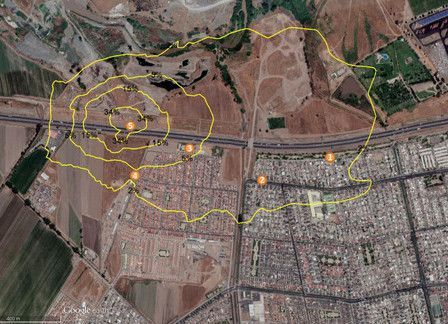
   Wastewater treatment plants (WWTPs) are fundamental for water ecosystems conservation but when they are located in the proximity of residential areas may produce odour nuisance. One of the most common odours pollutants emitted in WWTPs is hydrogen sulphide (H2S) and release to the atmosphere (in waste-waterfalls, manholes), producing a strong unpleasant smell. In this work, field olfactometry and H2S measurement enabled to identify the main odour source, located in the inlet of the WWTP.

   The maximum H2S concentration in this emission point measured was 15 ppm and odour concentration was D/T 60, enough high to produce odour nuisance despite they were produced in open atmosphere. By means of a thorough data analysis of the essential variables involved, such as wind speed, wind direction and the H2S concentrations in its role as the central pollutant, it could be shown via contrasting annual, monthly and daily patterns, that the probability to be affected for these residential areas is the highest in summer from 19:00 hours.

There is no translation available.

oic separation distances   A very interesting and open access paper will be published this month in the Journal of Environmental Management. This paper is signed by the well-known experts Marlon Brancher, Martin Piringer, Andreas F.Grauer and Günther Schauberger and deals with the interesting topic of setting up separation distances to avoid odour impacts.

   This study shows that the use of different odour impact criteria (OIC) produces different separation distances between odour sources and residential areas for an equivalent level of protection.

Weitere Beiträge …

All the content here under Creative Commons license