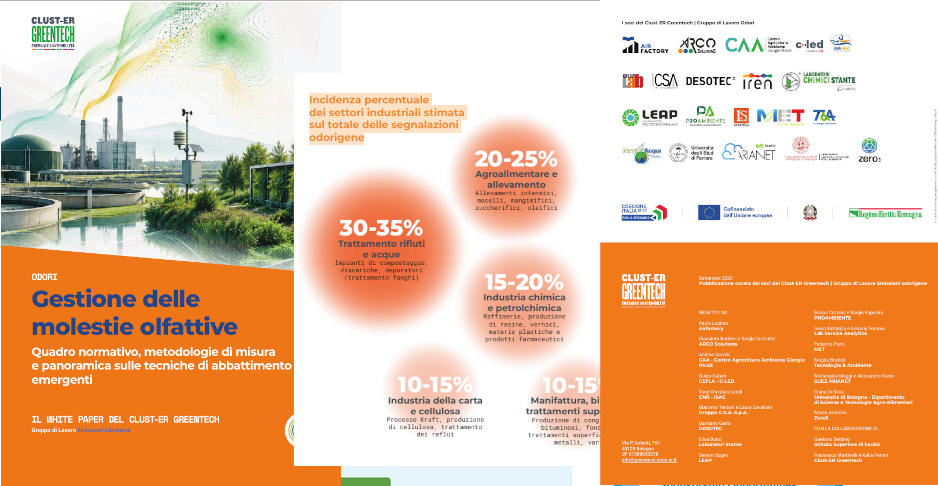
In September 2026, the Working Group on Odour Emissions of Clust-ER Greentech, the energy and sustainable development cluster of Italy's Emilia-Romagna region, published a free white paper titled "Gestione delle molestie olfattive" (Managing Odour Nuisance). The document maps the fragmented European and Italian legislation and explains the shift from emission limits towards receptor-based acceptability criteria. It also discusses dynamic peak-to-mean methods as an alternative to Italy's fixed factor of 2.3, and sets out the classification and verification requirements for instrumental odour monitoring systems (IOMSs) under UNI 11761. In addition, it reports that a new UNI working group is drafting a standard on citizen science for air quality.
The white paper was launched on 16 September 2026 at RemTech Expo in Ferrara, at an event attended by more than 100 people, and can be downloaded free of charge from the Clust-ER Greentech website.Its contributors include consultancies, laboratories, technology suppliers and research bodies such as CNR-ISAC, the University of Bologna, and the Istituto Superiore di Sanità. For anyone carrying out odour impact assessments, one the most interesting pages may be the ones on modelling. The white paper openly questions one of the most widely used conventions in Italian practice: a single multiplying factor that turns hourly model averages into odour peaks. It also points to alternatives that the national environmental agencies have recently started to cite. What the authors propose, and why it matters well beyond Italy, is explained below.
The authors describe it as a practical guide to existing rules for plant operators, regulators, consultants and laboratories, rather than a substitute for those rules.
On regulation, the white paper notes that there is still no EU directive dedicated to odour. The topic is handled indirectly through the Industrial Emissions Directive, as amended by Directive (EU) 2024/1785, and the BAT conclusions linked to it. In Italy, article 272-bis of Legislative Decree 152/2006 and the Ministry of the Environment's Directorial Decree No. 309 of 28 June 2023 now provide a common national framework. Regions may still apply stricter requirements. The document lists the regional instruments in force and reports that Abruzzo and Umbria aligned their rules with the national guidance in 2025.
The authors describe how regulation has moved from controlling emissions at the source to protecting receptors. Under this approach, odour concentrations at homes, schools and public areas are estimated with dispersion models and compared with acceptability criteria. These are usually expressed as the 98th percentile of hourly peak concentrations over a year, with stricter values for more sensitive areas. Because odour nuisance is highly intermittent, the guidelines recommend three-dimensional, non-stationary Lagrangian puff or particle models over simpler steady-state approaches.
The main methodological point concerns the peak-to-mean ratio. Odour is perceived over a single breath, whereas dispersion models produce averages over periods of usually an hour. Italian practice bridges this gap by multiplying the modelled hourly mean by a constant factor of 2.3. The white paper highlights dynamic alternatives, notably variance transport and micromixing methods, which are referred to in the technical document adopted by the National System for Environmental Protection (SNPA) through Resolution No. 268/2025. In these methods the ratio changes with time and position. It can be well above 2.3 when the mean concentration approaches zero and tends towards 1 as the mean increases.
This is relevant because, according to the SNPA document, the literature suggests that a fixed factor tends to underestimate odour concentrations in the near field, where the most exposed receptors are often located. The SNPA is nevertheless cautious. It still describes these methods as an area of active research with few real-world applications, rather than established regulatory practice. Further work and comparisons between methods will therefore be needed before they can replace the fixed factor in permitting.snpambiente
The white paper also covers IOMS in detail. Under the Italian standard UNI 11761:2023, they are classified into three types of measurement: presence or absence of odour (Type A), odour class (Type B), and odour quantity correlated with olfactometry (Type C). Type C is the only one that can serve as a surrogate for concentration in ouE/m³. The standard also sets three levels of verification, from initial acceptance to ongoing checks in the field. At European level, CEN/TC 264 Working Group 41 is preparing a document on the validation, calibration and performance of IOMS, so that they can be used in official monitoring.
The white paper also gives prominence to citizen participation. The authors report that a new working group has recently been set up within the UNI technical body on air quality (GL 4), with several cluster members taking part. Its aim is to propose a standard on citizen science for air quality that would harmonise how data are collected, stored, validated and evaluated, and how results are communicated.
The final section reviews abatement techniques. It covers established BAT such as wet scrubbers, activated carbon adsorption, thermal oxidation and biofiltration, including high-efficiency biofiltration with composite media. It also discusses emerging options such as advanced oxidation, high-pressure ozone misting, microbial inocula and landfill gas capture, while stressing that the right choice depends on each case.
Download this white paper here: https://greentech.clust-er.it/gestione-delle-molestie-olfattive-quadro-normativo-metodologie-di-misura-e-panoramica-sulle-tecniche-di-abbattimento/
