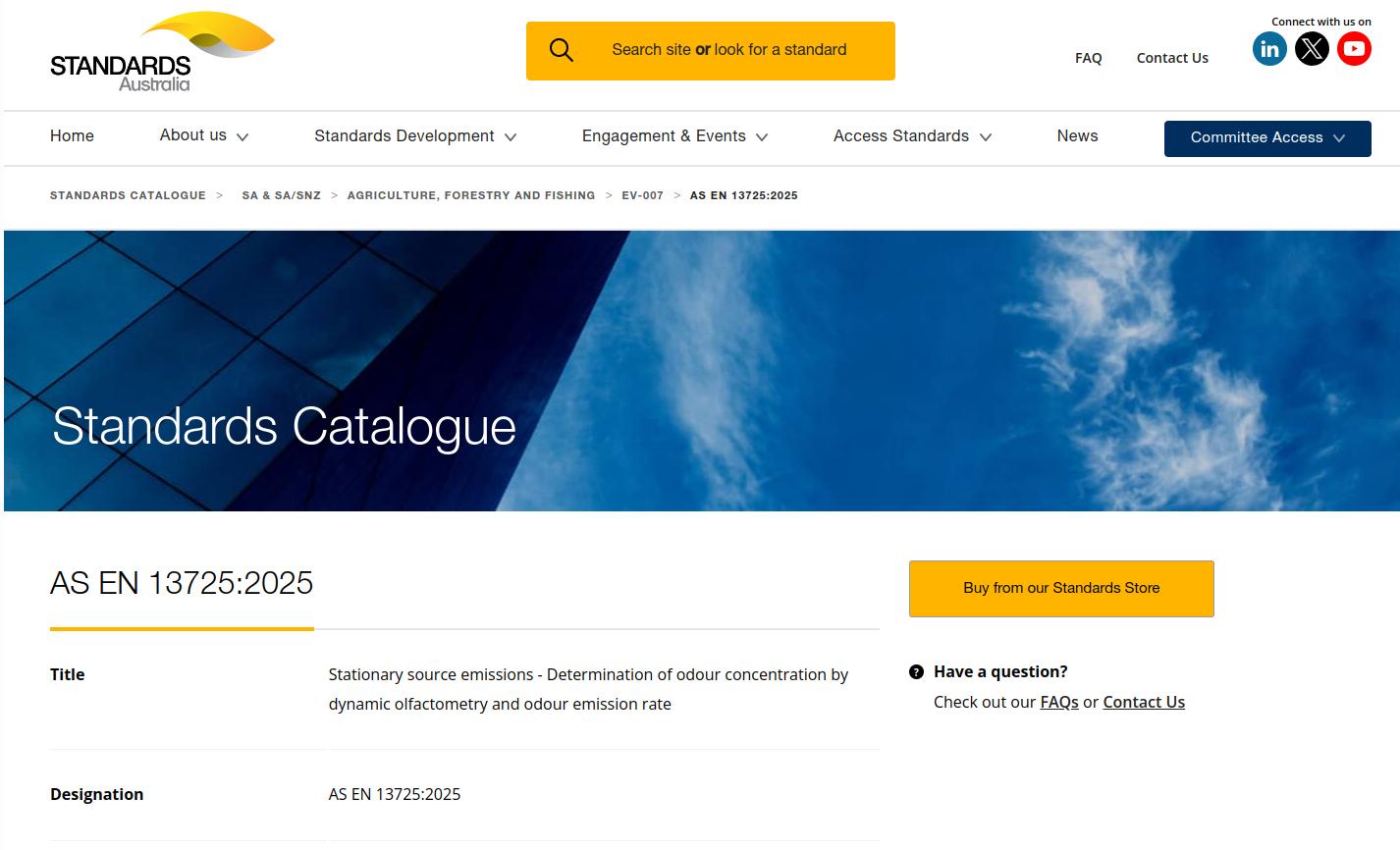
Australia has recently adopted the EN 13725:2022 standard for odour measurement, aligning its methodology with the latest European standard. The new AS EN 13725:2025 replaces the older AS/NZS 4323.3:2001, which was based on the 2003 European standard. The change introduces updates in calibration, uncertainty assessment, and sampling procedures.
For those involved in environmental monitoring and odour assessment, understanding this update is important. The adoption of a transposed standard means that Australia now uses the same methodology as Europe, ensuring consistency in measurements.
A transposition of a standard means adopting it verbatim so that all users apply the exact same method. Even a small change, such as a comma, can alter the method and its results. The former Australian/New Zealand standard, AS/NZS 4323.3:2001, was based on the 2003 European standard but could not replicate the same measurement unit because the methodology although similar, had changed. Now, with the recently published AS EN 13725:2025, Australia and Europe share the same measurement approach, and thus the same unit. This will make comparable the reports made in Australia and any of the 33 European countries under the umbrella of CEN. Maybe it is also the first step towards an ISO standard in the future.
Some members of CASANZ were reportedly surprised by the introduction of the new standard, as they had not been consulted during its development. This has raised concerns about transparency and involvement in the decision-making process for standards that affect the industry.
Another notable issue is that New Zealand has not adopted the new standard and continues to use AS/NZS 4323.3:2001. This means that, for now, odour measurement methodologies differ between Australia and New Zealand, despite the shared history of the previous standard.
There are some key changes in this new standard. Being maybe the most important ones.
- Greater emphasis on uncertainty: The new standard requires laboratories to address and quantify measurement uncertainty, improving the reliability of odour concentration results
- Secondary Odour Reference Mass (SROM): Introduced to provide better calibration and traceability, supplementing the use of n-butanol as the primary reference substance
- Improved sampling procedures: The 2022 standard includes more detailed recommendations for the sampling, storage, and handling of odour samples, aiming to reduce variability and improve data quality
- Refined quality assurance: Updated and more comprehensive requirements for quality control and method validation throughout the measurement process
- Better equipment: Many older olfactometers and sampling equipment may not meet the requirements of the new standard.
For more info on this standard, purchase the document here.
If you find this article interesting, you might be also interested in these articles.
- EN 13725:2022 is finally published!
- Highlights from the 2024 CASANZ and IWA Clean Air Conference
- How a European Standard about odours was born in 1991
- Is this the end of n-butanol for olfactometry?
