Carlos N. Díaz
SUMMARY
This article discusses the latest advances in determining the components responsible for odor emissions in a gas recently presented at the conference on odors in the environment in Baden-Baden, Germany.
Keywords. CGMS, dynamic olfactometry, odor thresholds, chemical characterization.
Abbreviations: CG: Gas Chromatography, MS: Mass Spectrometry, AAI: Integrated Environmental Authorization, EIA: Environmental Impact Assessment, SPME: Solid Phase Micro Extraction
In a TV Program
For some time now, an American TV program has been broadcasted on Saturday mornings dedicated to showing viewers the dirtiest and most dangerous jobs that exist. Recently, in one of the episodes dedicated to unpleasant jobs, an American company specializing in evaluating odors in various samples was featured. The challenge for the presenter was to bring a sample that was particularly odorous. After thinking about it for a bit, he decided that the most malodorous thing he could bring was a baby's diaper, so he boldly decided to try his luck at a daycare.
After inquiring with the daycare teachers about which of all the babies could provide the most aromatic diaper and personally evaluating some of the samples, the presenter found that he had made the right decision... all the diapers were terribly malodorous.
However, one of them had a special diet that made his excretions particularly aromatic. The program host was able to verify the truth of the daycare teachers' claims after a short time... it was indeed very odorous. After collecting his precious treasure, the presenter placed it in a suitable container. This is the moment when it is appropriate to reflect on how tricky sampling can be at times.
The presenter visited an American company specialized in measuring odors with this baby's feces sample. The challenge was to find out which substances were responsible for the intensely strong odor emitted by the sample.
The laboratory technician passed the headspace of the sample through a gas chromatograph coupled with a mass detector and an olfaction port. The presenter's task was to position himself at the sniffing port and indicate when he identified a characteristic odor. In the event he detected an odor, he had to indicate what type of odor he was detecting, associating it with various adjectives used as descriptors. Throughout the process, the scientist suggested to the presenter the most appropriate descriptor choices.
Finally, the laboratory technician concluded that there were 4 organic chemical compounds that could be representative of the overall odor of the baby's feces sample and that could be clearly identified by the character of their odor and their signal in the chromatographic footprint. The compounds identified in the research were dimethyl sulfite, dimethyl trisulfide, methyl mercaptan, and p-cresol. Each of these compounds was identified by a clear chromatographic peak.
Based on the identified organic chemical compounds and knowing the concentration of each, the laboratory technician prepared a solution from the bottles containing the pure compounds. By mixing the substances at the concentrations indicated by the chromatogram, a solution with an odor similar to that of the baby's feces was generated.
Television does not yet have the ability to reproduce odors, so it had to be believed that the solution diligently prepared by the researcher really smelled similar to the baby's feces.
Later on, it was confirmed that the presenter's choice of sample was not random. In this company, the results of research on baby feces were used to design trash bags that could effectively retain the odors produced by used diapers.
Can an Odor Really Be Reproduced?
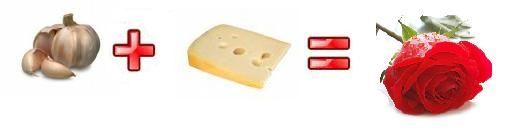 Although it was not the specific objective of this laboratory, many laboratories have unsuccessfully attempted to reproduce various complex odors by calculating the most relevant odorant concentrations and weighting them by the odor threshold of each substance.
Another application of this principle is determining the odor concentration of a mixture of substances based on the evaluation of the individual odor thresholds of each. There is actually an abundant literature with tables of odor thresholds for numerous volatile organic and inorganic compounds.
If we could proceed in this way, we would take our sample in a Tedlar© bag from an odor-emitting source and pass it through the CGMS(1).
Multiplying the concentrations of the detected substances by their individual odor thresholds would yield the odor concentration of the sample. Besides rendering the olfactometric panel members unemployed, we could get rid of our olfactometer and reduce the cost per sample. If this could be done, what would be the point of dynamic olfactometry once the individual odor thresholds have been determined?
This goal has been diligently sought, often on the other side of the Atlantic. The final conclusion of all the experiments conducted has been the same; in most cases, it is not possible to calculate the total odor concentration of a specific sample by multiplying the concentrations of the gases found in that sample by the odor thresholds of the considered substances.
The Challenge of Designing an Odor Control System Without Knowing the Chemical Nature of the Substances Emitted into the Atmosphere.
A little over a year ago, a highly skilled technician in industrial gas purification systems mentioned during a meal after a talk on olfactometry and odor pollution in Seville, the problems her company faced with some requirements from the relevant authorities that were very difficult to solve. The advent of Integrated Environmental Authorizations (AAIs) and the development of Environmental Impact Assessments (EIAs) had changed the rules of the game, and now the administration demanded certain limit values from industries, or specific purification efficiencies, often not regulated by horizontal legislation.
The story often unfolds in a similar way: The industry, sometimes compelled by the corresponding administration, conducts a study of its odor emissions indicating that to reduce the impact of its emissions on the nearby locality, it must install an odor reduction system. The pressure from the administration and often from the neighbors is such that there is no room for error. The administration instructs the industrial activity to comply with certain conditions, for example, to install an odor reduction system with 99% efficiency. Finally, the industrialists contact this technician and request a system that reduces the emitted odors with the required purification efficiency.
Traditionally, gas purification systems are designed considering typical parameters such as flow rate, mass concentration units, or physical characteristics, and suddenly a client asked her to consider the odor concentration. But what was that odor? What substances were part of it? The final conclusion of this technician was that a limit value for odors or a specific purification performance could not be demanded, since it was not known which compound or compounds could be responsible for the emission of these odors in a large portion of the cases. It was technically impossible to ensure an odor reduction performance if the chemical characteristics of this odor were not known, at least approximately. In other words, the administration was requiring very difficult compliance requirements from the holder of an industrial activity.
Finally, the technician from the gas purification system supplier performed a chemical speciation and qualitative characterization of a gas sample from the process in question, and based on the results of this analysis, it was estimated qualitatively which gases were responsible for the odor emission. One needs a lot of experience or very good knowledge of a specific process to assert that a particular chemical compound is responsible for the odor emission. And if you're lucky and only one volatile molecule is responsible for an odor; most of the time, it's a combination of compounds responsible for a specific odor, as was the case with baby feces. Lastly, it is not possible to predict the different interactions of the odoriferous substances within the gas matrix being analyzed due to effects like synergies, antagonisms, masking, etc.
Let's assume we have a gas allegedly odorous composed of 65 organic and inorganic molecules, of which we have selected 5 that, based on our extensive experience, we believe are responsible for the odor. However, one might wonder if the 5 substances contribute equally to the odor emission, or if there are some that contribute more. Perhaps this could be the key to adjusting the odor control system. However, the identification and distribution of the odor load of a mixture of odoriferous substances is carried out qualitatively to date based on each technician's personal experience and through trial and error tests.
Therefore, it is not possible to determine the actual odor reduction efficiency of the installed purification system until it is in place and running at full capacity. At least for a large part of industrial activities. It is only then that a gas sample can be taken and its odor concentration determined after the purification process. Then, we can accurately calculate the odor concentration of the sample and know whether an appropriate abatement system has been chosen, or not.
For this reason, and to be on the safe side, the equipment must be sized to achieve high removal efficiencies of the chemical substances estimated to be relevant in odor emissions, so that they can meet the required odor concentration limits without risks. Equipment that allows a certain degree of flexibility in aspects such as treated gas flow rate, amount of added reactant(s), fuel consumption, etc., should also be considered.
The final uncertainty about the suitability of the chosen odor control system is a concern for the industry, which does not really know if it has chosen the appropriate purification method until it is fully installed. It may happen that the odor emission has been corrected, but not enough to prevent complaints in nearby populations.
To be more precise, what concerns the industry is complying with the requirements of the competent authority and achieving the required odor reduction performance.
In the series of posters presented at the last conference on dynamic olfactometry and odors in the environment that took place in Baden-Baden a few months ago, several themes were addressed.
The last poster in the row (Schlegelmilch M. et. al.) was precisely about the characterization of a gas and the calculation of the influence of the components of this gas on the overall odor of the sample. This was done by determining the components of the gas using a more or less advanced technique (GC-MS+SPME) and multiplying the area of the chromatogram that identified these compounds by their odor threshold.
I must say that I had already read similar articles in some scientific literature, and the conclusion is always similar: it is not possible to calculate the odor concentration of the gas by summing the concentrations of the compounds that formed the gas by their corresponding odor thresholds since synergistic effects are not sufficiently studied.
However, the object of the study was not exactly to calculate an odor concentration, but rather to compare the contribution of each of the substances found in the gas to the total odor concentration using a tool called odor index.
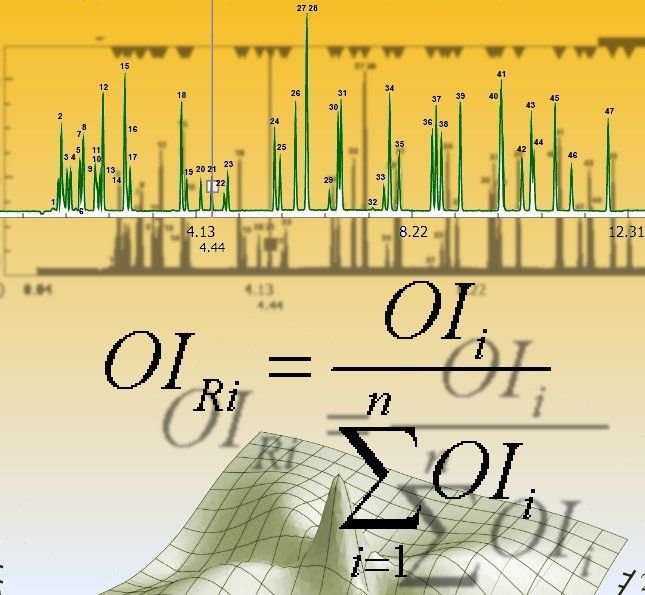
The odor index(2) was introduced some years ago as a tool to identify key compounds responsible for a specific odor. The odor index describes the potential contribution of each individual component to the accumulated odor impression. The calculation of the odor index for each individual component(3) follows the following equation:

Where OIij: odor index of compound i, OIRi: relative odor index of compound i (%) ai: peak area within the chromatogram, OTi: odor threshold of substance i and n: number of identified odoriferous substances in the sample.
If this calculation were done for each of the identified substances, a table similar to this one would be obtained:
|
Substance |
Odour Index OI% |
Average value |
||||
|
|
|
|
|
|
|
|
|
alcohol 1 |
|
0% |
1% |
1% |
|
1% |
|
alcohol 2 |
|
0% |
0% |
0% |
|
0% |
|
alcohol 6 |
|
1% |
3% |
1% |
|
2% |
|
aldehyde 1 |
|
0% |
0% |
0% |
|
0% |
|
aldehyde 2 |
|
15% |
10% |
6% |
|
10% |
|
aldehyde 3 |
|
0% |
0% |
0% |
|
0% |
|
Aromatic 1 |
|
1% |
0% |
0% |
|
0% |
|
Aromatic 2 |
|
55% |
61% |
69% |
|
62% |
|
Aromatic 3 |
|
0% |
0% |
0% |
|
0% |
|
deriv. Sulphur 1 |
|
0% |
0% |
0% |
|
0% |
|
deriv. Sulphur2 |
|
8% |
10% |
11% |
|
10% |
|
deriv. Sulphur 3 |
|
0% |
1% |
0% |
|
0% |
|
Heterocyc. Carbon 1 |
|
1% |
1% |
0% |
|
1% |
|
Heterocyc. Carbon 2 |
|
0% |
0% |
0% |
|
0% |
|
Heterocyc. Carbon 3 |
5% |
1% |
1% |
|
2% |
|
|
deriv nitrogen 1 |
|
0% |
0% |
0% |
|
0% |
|
deriv. nitrogen 2 |
|
9% |
7% |
6% |
|
7% |
|
deriv. nitrogen 3 |
|
4% |
4% |
3% |
|
4% |
|
|
|
|
|
|
|
|
|
Sum OI% ≥1% |
|
99% |
99% |
98% |
|
99% |
|
Sum OI% >5% |
|
92% |
88% |
92% |
|
89% |
For example, if we take the group of substances with a contribution greater than 1% to the total odor emission, we would only work with 6 substances out of the total detected organic molecules. Specifically, these compounds would be eliminated: alcohol 6, aldehyde 2, aromatic compound 2, sulfur derivative 2, heterocyclic compound 3, and nitrogen derivatives 2 and 3.
If we consider the group of substances with a contribution greater than 5%, the set of compounds to be dealt with would be further reduced to 4 (aldehyde 2, aromatic compound 2, sulfur derivative 2, and nitrogen derivative 2).
In this poster, other very interesting tables were presented that showed that once the substances responsible for odor emission were found, it was possible to implement an odor control system much more adapted to a specific profile of substances(4).
Once the odor control system was installed, significant odor reduction performances were demonstrated with much greater optimization in terms of energy and consumed reagents.
This way, although we may not be able to reproduce the baby's poop smell exactly, or even calculate the total odor concentration based on the individual odor thresholds of the odoriferous components, we can assist our expert technician in choosing an odor abatement method optimized for the client's and administration's needs.
(1) Preconcentration recommended (SPME, tenax®, etc)
(2) In the literature, numerous odor indices can be found unrelated to the one described in this article. Link 1, Link 2, Link 3.
(3) Whenever an odor threshold is available
(4) More information on this topic can be found in the document Methoden zur Bewertung und Verminderung von Geruchsemissionen. GERUCHSMANAGEMENT (Methods for the Assessment and Reduction of Odor Emissions). Mirko Schlegelmilch, which can be downloaded here. For inquiries about the method, see the following website: www.odocon.d
